The 2026 FIFA World Cup has proven that expansion does not necessarily mean dilution. With 48 teams competing across North America, the tournament has delivered shocks, compelling narratives, and the emergence of nations that would never have qualified under the old 32-team format. Morocco's run to the semi-finals, the competitive performances of Asian and African qualifiers, and the global television audiences have emboldened FIFA's expansionist faction.
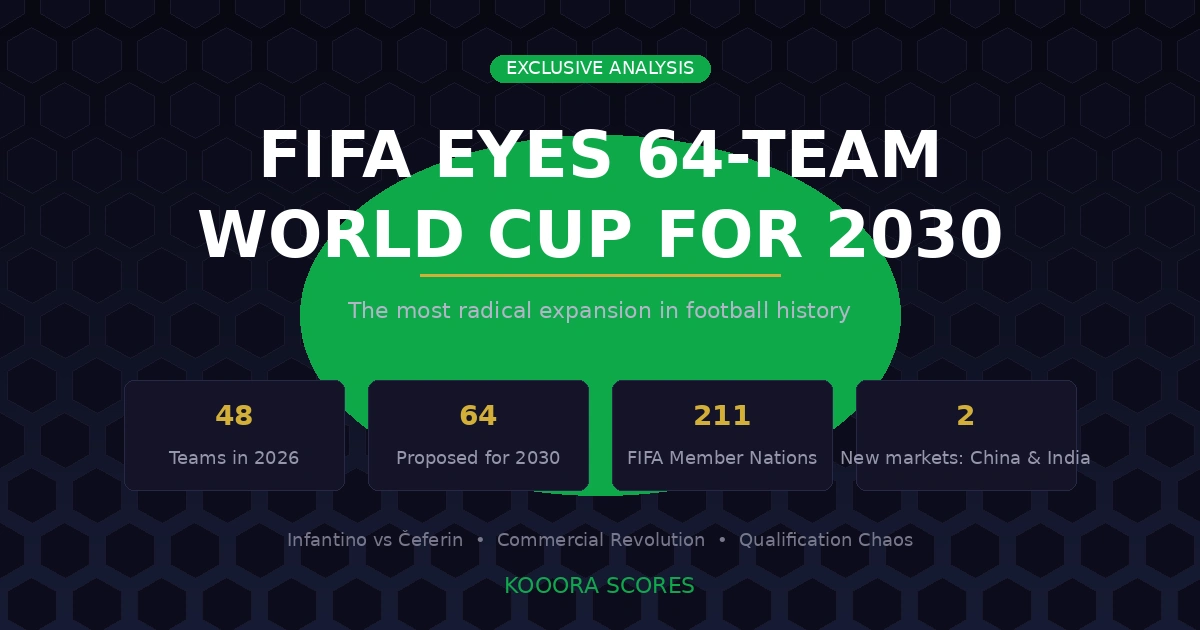
Now, with the 2026 tournament still unfolding, FIFA President Gianni Infantino has revealed that the governing body is actively reviewing a proposal to expand the 2030 World Cup to 64 national teams. The announcement, made as the 2026 competition reaches its decisive phase, has sent shockwaves through the football establishment — not because the idea is new, but because Infantino's endorsement makes it a genuine possibility rather than a theoretical debate.
💬 Infantino on the 64-Team Proposal
"That's definitely an issue that will be examined and discussed in the relevant committees after this World Cup. When organizing a World Cup, it's important to organize it for the whole world — not just Europe and South America. If you don't give smaller countries a chance to participate in the World Cup, they'll lack the incentive to keep improving."
— Gianni Infantino, FIFA President, via BlueWin
The Arithmetic of Expansion: From 32 to 48 to 64
To understand the magnitude of what FIFA is proposing, it is worth tracing the trajectory of World Cup expansion. The tournament remained at 32 teams from 1998 through 2022 — a 24-year period that saw football globalize dramatically but the competition format remain static. The 2026 expansion to 48 teams represented a 50% increase; the proposed 2030 expansion to 64 would represent a 100% increase from the 2022 baseline and a 33% increase from the 2026 format that has not even been fully evaluated yet.
| Edition | Teams | Matches | Host(s) | Format Change |
|---|---|---|---|---|
| 1998–2022 | 32 | 64 | Various | 8 groups of 4 |
| 2026 | 48 | 104 | USA / Canada / Mexico | 12 groups of 4 + R32 |
| 2030 (Proposed) | 64 | ~128 | Morocco / Portugal / Spain + Uruguay / Argentina / Paraguay | 16 groups of 4 + R32 |
A 64-team tournament would require approximately 128 matches — double the number played at France 1998 and roughly 23% more than the 2026 edition. The logistical, financial, and sporting implications of such a scale are staggering. The 2030 hosts — Morocco, Portugal, and Spain for the bulk of the tournament, with Uruguay, Argentina, and Paraguay hosting the opening matches to commemorate the centenary — would need to provide infrastructure for a competition that would last longer and consume more resources than any previous World Cup.
The Power Brokers: Who Supports It and Who Opposes It
The 64-team proposal has already divided football's most powerful administrators along predictable lines. The split is not merely philosophical — it reflects competing commercial interests, regional ambitions, and fundamentally different visions of what the World Cup should represent.
The Pro-Expansion Camp
Gianni Infantino is the proposal's most influential advocate. His argument is explicitly political and developmental: the World Cup must be "for the whole world," not just the traditional powerhouses of Europe and South America. Infantino's rhetoric frames expansion as a moral imperative — smaller nations need the World Cup as an incentive to invest in football infrastructure, coaching, and youth development. This is consistent with his broader FIFA presidency, which has prioritized increasing development funding to confederations outside UEFA and CONMEBOL.
Alejandro Domínguez, president of CONMEBOL, has also publicly endorsed the 64-team vision. In an interview in November 2025, Domínguez described a 64-team tournament as his "dream" — a striking position given that South America already receives generous World Cup allocation relative to its confederation size. Domínguez's support likely reflects CONMEBOL's desire to maintain influence in a FIFA increasingly oriented toward Africa and Asia, as well as the commercial benefits of having more South American teams in the competition.
The Opposition
Aleksander Čeferin, president of UEFA, has emerged as the most prominent critic. Speaking at a UEFA media conference in Belgrade in April 2026, Čeferin described the 64-team proposal as a "bad idea" that would "significantly affect the qualification process." His opposition is rooted in European self-interest — UEFA already receives the largest World Cup allocation, and further expansion would dilute European representation proportionally while potentially reducing the competitive standard of the tournament. Čeferin's stance also reflects a broader European skepticism of Infantino's expansionist agenda, which many European federations view as politically motivated and commercially reckless.
"Organize it for the whole world — not just Europe and South America." Champions global inclusion and development incentives for smaller nations.
Called a 64-team tournament his "dream" in November 2025. Supports expansion to maintain South American influence and increase commercial opportunities.
"A bad idea" that would "significantly affect the qualification process." Opposes on competitive and logistical grounds, protecting European interests.
African and Asian confederations likely to support expansion, as they would receive the largest proportional increases in World Cup slots.
The China and India Factor: Commerce Disguised as Inclusion
While Infantino frames the 64-team proposal in the language of development and inclusion, the commercial subtext is impossible to ignore. Two nations, in particular, would benefit disproportionately from expansion: China and India — the world's two most populous countries, with a combined population of nearly 2.9 billion people, neither of which has ever qualified for a FIFA World Cup.
The commercial logic is brutally simple. World Cup broadcasting rights, sponsorship deals, and merchandise sales in China and India are currently limited by the absence of national team participation. Chinese and Indian fans watch the World Cup, but without emotional investment in their own country's progress, the commercial return is a fraction of what it could be. If expansion to 64 teams created a realistic pathway for China and India to qualify — and given their confederation sizes, it almost certainly would — FIFA would unlock two of the world's largest consumer markets at a stroke.
China has invested billions in football infrastructure over the past decade, from stadium construction to youth academies to hosting the 2023 AFC Asian Cup. Yet the national team remains competitive only within Asia, not globally. India's football development has been slower, but the Indian Super League and growing domestic interest suggest a market primed for activation. A World Cup qualification for either nation would trigger an explosion of commercial interest — new broadcast deals, sponsorship partnerships, and grassroots investment that would flow directly to FIFA's revenue streams and confederation development funds.
🌍 The Commercial Equation
China Population: 1.4 billion | India Population: 1.4 billion | Combined: ~2.8 billion (35% of world population)
World Cup Appearances: China: 1 (2002) | India: 0
Current FIFA Rankings: China: ~90th | India: ~120th
Projected 64-Team Allocation: Asia (AFC) would likely receive 12-14 slots, making qualification realistic for both nations.
What 64 Teams Would Mean for the Tournament
A 64-team World Cup is not merely a larger version of the current tournament — it would require fundamental restructuring of the competition format, qualification system, and calendar. The most likely format would involve 16 groups of four teams, with the top two from each group advancing to a Round of 32, followed by standard knockout rounds. This would produce approximately 128 matches, extending the tournament to roughly 40 days from the current 30-35 day window.
The implications cascade through every aspect of international football:
- Qualification Chaos: The qualification process would need radical simplification. With 64 of 211 FIFA member nations qualifying, nearly one-third of all member associations would reach the finals. Some confederations might abandon traditional qualification tournaments in favor of regional league formats or direct invitations based on ranking.
- Player Welfare Crisis: The 2026 expansion already stretched the international calendar to breaking point. A 64-team tournament with 128 matches would require an additional 7-10 days, compressing domestic league schedules further and increasing the physical load on elite players who already play 60+ matches per season.
- Host Infrastructure Strain: The 2030 hosts would need to provide 16-20 stadiums capable of hosting World Cup matches, plus training facilities, accommodation, and transport infrastructure for 64 delegations. The cost would run into tens of billions of dollars — a burden that only the wealthiest nations or multi-nation coalitions could bear.
- Competitive Dilution: The most common criticism is that expansion reduces the competitive standard. The 2026 tournament has largely disproved this at the 48-team level, but 64 teams would push the boundary further. Matches between top-10 nations and teams ranked 60-64 would likely produce one-sided results that damage the tournament's prestige.
- Broadcast and Fan Fatigue: 128 matches over 40 days is a marathon. Broadcasters and fans already struggle to maintain engagement through the full 104-match 2026 schedule. Further expansion risks creating a tournament so long that it becomes background noise rather than a concentrated global spectacle.
The 2030 Context: A Centenary Tournament Under Pressure
The timing of this proposal is politically significant. The 2030 World Cup will mark the centenary of the first tournament, held in Uruguay in 1930. FIFA has already awarded the opening matches to Uruguay, Argentina, and Paraguay — a symbolic gesture acknowledging South America's foundational role in World Cup history — before the main tournament moves to Morocco, Portugal, and Spain. This six-nation hosting arrangement is itself unprecedented and logistically complex; adding a 64-team format would compound the challenges exponentially.
Morocco's role as a primary host is particularly relevant. The North African nation has invested heavily in football infrastructure following its historic semi-final run at the 2022 World Cup and its successful bid for the 2025 Africa Cup of Nations. A 64-team tournament would require Morocco to host more matches and more teams than originally planned, potentially straining stadium capacity in cities like Casablanca, Marrakech, and Rabat. The same applies to Portugal and Spain, which would need to expand their venue portfolios beyond the 15-20 stadiums currently envisioned.
Historical Precedent: Has Expansion Worked Before?
The history of World Cup expansion offers mixed evidence. The 1982 expansion from 16 to 24 teams introduced a second group stage that many fans found confusing and anti-climactic. The 1998 expansion to 32 teams is widely regarded as a success — it gave opportunities to African and Asian nations without noticeably diluting quality, and the group-of-16 format became the tournament's defining structure for 24 years.
The 2026 expansion to 48 teams is the most relevant precedent, and early evidence is cautiously positive. The group stage has produced competitive matches between established nations and qualifiers from smaller confederations. Television ratings have remained strong. The commercial returns have justified FIFA's investment. However, the knockout phase — where the tournament's true quality is measured — is still unfolding. If the Round of 32 and beyond maintain competitive integrity, Infantino will have powerful evidence that further expansion is viable. If the knockout phase reveals a significant quality gap, Čeferin's arguments will gain traction.
What Happens Next: The Decision Timeline
Infantino has stated that the 64-team proposal will be "examined and discussed in the relevant committees after this World Cup." This means the formal review process will likely begin in late 2026 or early 2027, with a decision required by 2028 at the latest to allow the 2030 hosts sufficient preparation time. The FIFA Council, which includes representatives from all six confederations, will ultimately vote on any format change — and the voting arithmetic will be determined by which confederations believe they stand to gain or lose from expansion.
UEFA's opposition is significant but not necessarily decisive. If CAF (Africa), AFC (Asia), CONCACAF (North/Central America), and OFC (Oceania) all support expansion — and they would all receive additional slots — UEFA and CONMEBOL could be outvoted. The key variable is whether the smaller confederations believe the benefits of additional slots outweigh the risks of competitive dilution and calendar congestion.
⚖️ The Kooora Scores Verdict
The 64-team World Cup proposal is likely to pass. Infantino has built his presidency on expansion and inclusion; the commercial case for unlocking China and India is overwhelming; and the voting arithmetic favors confederations that would receive additional slots. UEFA's opposition will delay but not prevent the change. The real question is not whether 64 teams will happen, but whether FIFA can design a format that maintains competitive integrity while delivering on its promise of a truly global tournament. The 2026 knockout phase will provide the evidence that decides the debate.
Key Takeaways
- FIFA is actively reviewing a proposal to expand the 2030 World Cup to 64 teams — the most radical format change in tournament history.
- Gianni Infantino supports expansion on developmental and inclusion grounds, arguing that smaller nations need World Cup participation as an incentive to invest in football.
- Aleksander Čeferin opposes the proposal, calling it a "bad idea" that would damage the qualification process and competitive standard.
- China and India are the commercial drivers — two nations with 2.8 billion people and zero combined World Cup appearances would become realistic qualifiers under a 64-team format.
- The 2030 hosts face unprecedented logistical challenges — Morocco, Portugal, Spain, Uruguay, Argentina, and Paraguay would need to accommodate 64 teams and ~128 matches.
- A decision is expected by 2028, following post-2026 tournament review by FIFA committees and a Council vote.
Stay tuned to Kooora Scores for live coverage of the 2026 World Cup final stages, and ongoing analysis of FIFA's expansion proposals as they develop.