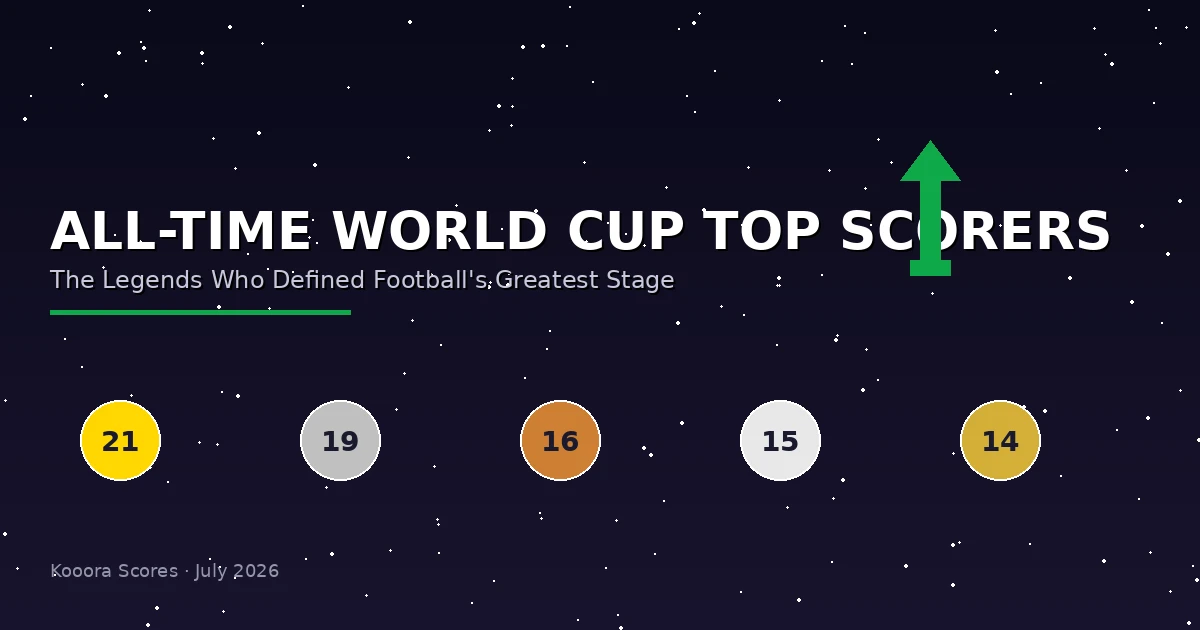
The FIFA World Cup is not merely a tournament — it is the crucible where footballing legends are forged. Every four years, the planet's finest players converge under the brightest spotlight, and while trophies define teams, goals define individuals. Since Uruguay 1930, hundreds of players have graced the stage, but only a select few have etched their names into the annals of history as the competition's most prolific marksmen.
As the 2026 FIFA World Cup unfolds across Canada, Mexico, and the United States, the all-time scoring charts have been rewritten once again. What was once a stable hierarchy dominated by German and Brazilian greats has been upended by two modern superstars whose rivalry has electrified this edition and reshaped our understanding of what is possible on football's grandest stage.
The New King: Lionel Messi's Record Reign
Lionel Messi currently stands alone at the summit of World Cup goalscoring history with 21 goals. It is a tally that seemed unimaginable when the Argentine first appeared at Germany 2006 as an 18-year-old substitute, scoring just once in three appearances. But what followed was a masterclass in longevity, adaptability, and sheer brilliance.
Messi's World Cup journey reads like a crescendo: four goals in Brazil 2014, where he dragged Argentina to the final and won the Golden Ball; a solitary strike in Russia 2018 during a tournament of frustration; and then the explosion — seven goals in Qatar 2022, culminating in a mesmerizing final performance against France that finally delivered the trophy he craved. Now, in 2026, he has added eight more, breaking the record outright and leaving the chasing pack with a mountain to climb.
What makes Messi's achievement remarkable is not merely the volume but the context. He has scored against 14 different nations across six tournaments, converting in knockout stages with the same cold efficiency as in group games. His 21 goals have come in 31 matches — a rate of 0.68 per game — and include strikes in three separate World Cup finals, a feat unmatched in the competition's history.
The Hunter: Kylian Mbappé's Relentless Chase
If Messi sits on the throne, Kylian Mbappé is the usurper at the gates. The French phenomenon has amassed 19 goals across just three editions and 19 games — a staggering average of exactly one goal per match that puts him on a trajectory to potentially obliterate every record in the book.
Mbappé announced himself to the world at Russia 2018 with four goals, including a blistering performance in the final against Croatia that made him the second teenager — after Pelé — to score in a World Cup decider. In Qatar 2022, he elevated himself to another plane entirely with eight goals, including a hat-trick in the final against Argentina that very nearly snatched the trophy from Messi's grasp. Now, in North America 2026, he has added seven more and sits just two behind the Argentine with potentially years of World Cup football ahead of him.
At 27, Mbappé could feature in at least two more tournaments. If he maintains anything close to his current rate, he could finish his international career with 30 or more World Cup goals — a figure that would place him in a stratosphere of his own. The question is no longer whether he will catch Messi, but when.
The German Machines: Klose, Müller & Co.
Before the Messi-Mbappé era rewrote the record books, Miroslav Klose stood as the undisputed king of World Cup scoring. The German striker's record of 16 goals, set across four tournaments between 2002 and 2014, stood for twelve years and seemed virtually untouchable. Klose's genius was not flash or flair — it was ruthless, mechanical efficiency. Five goals in Korea/Japan, five on home soil in 2006, four in South Africa, and two in Brazil, where he surpassed Ronaldo's previous record of 15 and lifted the trophy in his final appearance.
Klose's compatriot Gerd Müller — "Der Bomber" — remains arguably the most devastating finisher per-minute in World Cup history. His 14 goals in just 13 games across the 1970 and 1974 editions represent a rate of 1.08 goals per match, the highest among any player with ten or more goals. Müller scored ten goals in Mexico 1970 alone, a single-tournament haul that has only been bettered once — by France's Just Fontaine, whose 13 goals in Sweden 1958 remain a record that may never be broken.
Germany's love affair with World Cup goalscoring extends further. Jürgen Klinsmann (11 goals in 17 games), Helmut Rahn (10 in 10), and Thomas Müller (10 in 19) all feature in the top 17, making Germany the most represented nation on the all-time list — a testament to their consistent tournament pedigree and the clinical finishing culture that defines their footballing identity.
The Brazilian Icons: Ronaldo and Pelé
No discussion of World Cup greatness is complete without Brazil's twin titans. Ronaldo Nazário scored 15 goals in 19 games across four tournaments, winning titles in 1994 and 2002. His redemption arc — from the seizures and heartbreak of the 1998 final to the Golden Boot and championship in Japan/Korea four years later — remains one of sport's most compelling narratives. Ronaldo's blend of explosive pace, balletic dribbling, and predatory instinct made him the complete striker, and his record stood as the benchmark for a decade until Klose surpassed it.
Pelé, the original GOAT, sits eighth on the all-time list with 12 goals in 14 games. What the numbers do not capture is the context: Pelé was a 17-year-old phenomenon when he scored six goals in Sweden 1958, including a hat-trick in the semi-final and two in the final. He added one in 1962, four in 1966 (though injury curtailed that campaign), and one in 1970 as part of arguably the greatest team ever assembled. Pelé's goals-per-game ratio of 0.86 is elite, and his three World Cup winners' medals remain unmatched.
The Complete Ranking: Every Player with 10+ Goals
| Rank | Player | Nation | Goals | Games | Tournaments |
|---|---|---|---|---|---|
| 1 | Lionel Messi | 🇦🇷 Argentina | 21 | 31 | 6 (2006–2026) |
| 2 | Kylian Mbappé | 🇫🇷 France | 19 | 19 | 3 (2018–2026) |
| 3 | Miroslav Klose | 🇩🇪 Germany | 16 | 24 | 4 (2002–2014) |
| 4 | Ronaldo Nazário | 🇧🇷 Brazil | 15 | 19 | 4 (1994–2006) |
| 5 | Gerd Müller | 🇩🇪 Germany | 14 | 13 | 2 (1970–1974) |
| 5 | Harry Kane | 🏴 England | 14 | 15 | 3 (2018–2026) |
| 7 | Just Fontaine | 🇫🇷 France | 13 | 6 | 1 (1958) |
| 8 | Pelé | 🇧🇷 Brazil | 12 | 14 | 4 (1958–1970) |
| 9 | Sándor Kocsis | 🇭🇺 Hungary | 11 | 5 | 1 (1954) |
| 10 | Jürgen Klinsmann | 🇩🇪 Germany | 11 | 17 | 3 (1990–1998) |
| 10 | Cristiano Ronaldo | 🇵🇹 Portugal | 11 | 26 | 6 (2006–2026) |
| 12 | Helmut Rahn | 🇩🇪 Germany | 10 | 10 | 2 (1954–1958) |
| 12 | Gabriel Batistuta | 🇦🇷 Argentina | 10 | 12 | 3 (1994–2002) |
| 12 | Gary Lineker | 🏴 England | 10 | 12 | 2 (1986–1990) |
| 12 | Teófilo Cubillas | 🇵🇪 Peru | 10 | 13 | 3 (1970–1982) |
| 12 | Thomas Müller | 🇩🇪 Germany | 10 | 19 | 4 (2010–2022) |
| 12 | Grzegorz Lato | 🇵🇱 Poland | 10 | 20 | 3 (1974–1982) |
The Race Is On: 2026 and Beyond
🏁 The Race for World Cup Immortality
With England still competing in the 2026 tournament, Harry Kane has the opportunity to climb further up the rankings. Mbappé, meanwhile, remains the most likely candidate to eventually surpass Messi's record.
The Stories Behind the Numbers
Beyond the raw statistics lie fascinating narratives that illuminate the evolution of World Cup football. Just Fontaine's 13 goals in a single tournament — Sweden 1958 — remains one of the most remarkable achievements in sporting history. The French striker achieved the feat in just six games, including four against defending champions West Germany in the third-place playoff. No player has come within five goals of his single-edition record in the 68 years since.
Sándor Kocsis of Hungary matched Fontaine's tournament intensity with 11 goals in five games at Switzerland 1954, including two hat-tricks. His national team — the legendary "Magical Magyars" — were undefeated in 31 matches before the final, where they controversially lost to West Germany in what became known as the "Miracle of Bern." Kocsis never played in another World Cup, making his 11-goal tally all the more extraordinary.
Cristiano Ronaldo's presence on the list is a study in longevity over peak performance. His 11 goals in 26 games across six tournaments represent a rate of 0.42 per match — respectable but nowhere near the elite tier. Yet his ability to remain relevant and dangerous at 41, still competing in 2026, is a testament to his unparalleled physical conditioning and mental fortitude. Ronaldo may not be the most efficient World Cup scorer, but he is unquestionably one of the most persistent.
What the Future Holds
The 2026 World Cup has already reshaped the all-time rankings, and with the tournament still in its knockout stages, more history could be written. Harry Kane sits level with Gerd Müller on 14 goals and has the opportunity to pull clear if England advance deep into the competition. At 32, this may be his final World Cup, adding emotional weight to every chance he converts.
But the real story is Mbappé. At 27, with a goal-per-game ratio that dwarfs every player on the list, the Frenchman represents the future of this record. If he plays in 2030 and 2034 — and maintains even 70% of his current scoring rate — he could finish with 28-32 World Cup goals, a figure that would likely stand for generations. The only question is whether Messi, at 39, has one more tournament in him to extend his lead and make the chase even more tantalizing.
What is certain is that the World Cup goalscoring record has never been more hotly contested. For decades, it was a German preserve — Klose, Müller, Rahn, Klinsmann — reflecting their tournament consistency. Then came the Brazilian era with Ronaldo and Pelé. Now, in the 2020s, it is a battle between an Argentine genius defying time and a French phenomenon rewriting the rules of what a footballer can achieve. The beautiful game, in its most beautiful form.
🔗 More on Kooora Scores
Key Takeaways
- Messi's Reign: With 21 goals across six tournaments, Lionel Messi is the all-time leading World Cup scorer and the only player to score in three separate finals.
- Mbappé's Pace: Kylian Mbappé's 19 goals in 19 games (1.0 per match) puts him on track to potentially reach 30+ World Cup goals by the end of his career.
- German Dominance: Germany has five players in the top 17, reflecting their remarkable consistency across nearly a century of World Cup football.
- Fontaine's Record: Just Fontaine's 13 goals in a single tournament (1958) remains the most unbreakable record in World Cup history.
- The Kane Factor: Harry Kane's 14 goals place him among the elite, and with England still competing in 2026, he could climb further before the tournament ends.
Stay tuned to Kooora Scores for live match updates, post-match analysis, and complete coverage of the 2026 FIFA World Cup as the race for the Golden Boot — and history — continues.