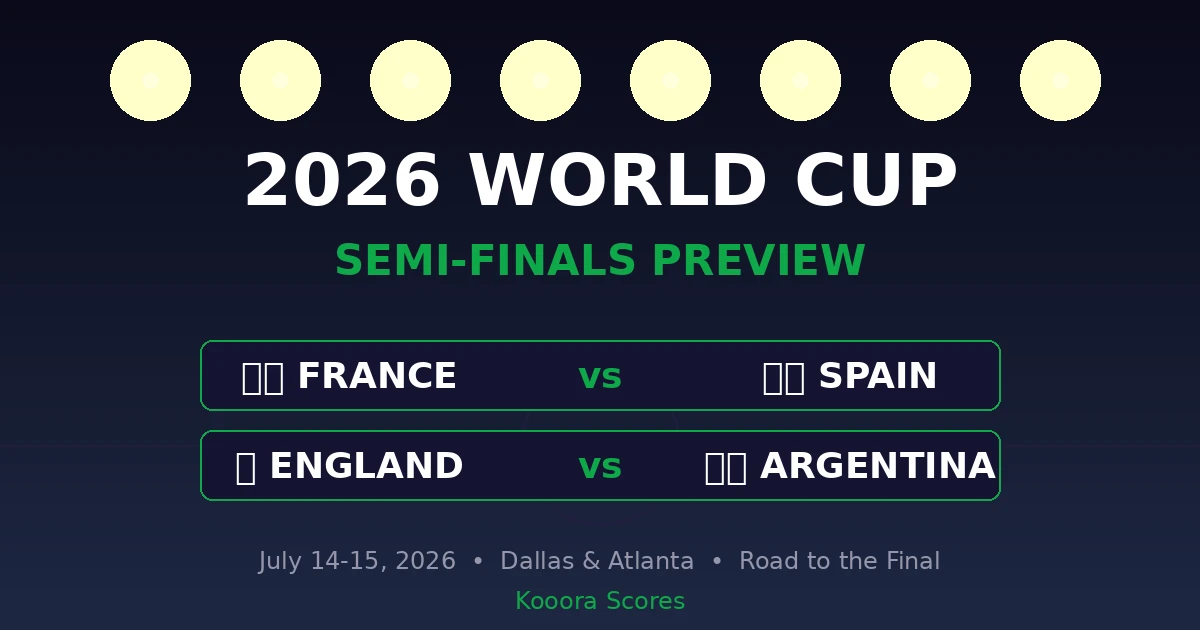
The 2026 FIFA World Cup has delivered everything promised by its expanded 48-team format — shocks, comebacks, and the emergence of new stars on football's biggest stage. Now, with 44 nations eliminated, the tournament narrows to its essential core: four footballing superpowers, two titanic semi-finals, and one golden trophy waiting in the New York metropolitan area on July 19.
The semi-final bracket presents a fascinating geographical and stylistic split. On Tuesday, July 14, France and Spain renew one of European football's most storied rivalries at Dallas Stadium — a match many observers are already calling "the final before the final." Twenty-four hours later, on Wednesday, July 15, England and Argentina collide at Atlanta Stadium in a fixture heavy with historical baggage, from the Hand of God to the modern era's tactical chess matches. Both fixtures kick off at 9:00 p.m. Morocco time (2:00 p.m. local), ensuring peak global viewership.
The Semi-Final Matchups at a Glance
Route: Sweden, Paraguay, Morocco
Route: Austria, Portugal, Belgium
Route: DR Congo, Mexico, Norway
Route: Egypt, Switzerland
France vs Spain: A Continental Classic in Texas
When France and Spain walk onto the pitch at Dallas Stadium on July 14, they will be continuing a rivalry that has defined European football for over a century. Yet this specific iteration carries unique weight. For France, it represents the penultimate chapter of Didier Deschamps' remarkable managerial saga — the 56-year-old has announced his departure after the tournament, win or lose, and nothing would crown his legacy like a third World Cup final appearance in eight years.
Deschamps has built a French squad that embodies his own playing philosophy: ruthless efficiency married to defensive steel. Les Bleus have navigated the knockout phase without requiring extra time, dispatching Sweden, Paraguay, and Morocco with a clinical precision that recalls their 2018 triumph. The French defensive structure — compact, vertically narrow, and devastating in transition — has conceded fewer clear-cut chances than any remaining side. Their ability to absorb pressure and strike through Kylian Mbappé and Ousmane Dembélé's pace on the counter has made them the tournament's most tactically predictable yet hardest-to-stop force.
Spain, under Luis de la Fuente, offer the stylistic counterpoint. La Roja arrive in Dallas on a 36-match unbeaten streak — one of the longest in international football history — and have produced arguably the most aesthetically pleasing football of the tournament. Their journey through Austria, Portugal, and Belgium showcased a pressing system that suffocates opponents in their own half, combined with midfield rotation that creates numerical overloads in the most dangerous areas of the pitch.
🎯 Key Tactical Battle: Transition vs Control
The central question of this semi-final is whether Spain can maintain their possession dominance against France's lethal transition game. When Spain lose the ball — typically high up the pitch due to their aggressive press — they are vulnerable to France's vertical passing and the acceleration of Mbappé. Conversely, if Spain can pin France in their own half and prevent counter-attacking launch points, they may suffocate Les Bleus' primary weapon.
Watch for the duel between Spain's midfield generals (Rodri and Fabián Ruiz) and France's defensive screen (N'Golo Kanté and Aurélien Tchouaméni). Whoever controls the middle third likely controls the match.
England vs Argentina: History, Pride, and a Place in the Final
The second semi-final is freighted with more historical weight than any fixture at the 2026 tournament. England and Argentina have produced some of the World Cup's most iconic moments — from Diego Maradona's Hand of God and Goal of the Century in 1986, to David Beckham's red card and Michael Owen's wonder-goal in 1998, to the penalty shootout trauma of 2022. When they meet at Atlanta Stadium on July 15, both nations will be playing for more than a final place; they will be writing the next chapter in one of football's most emotionally charged rivalries.
England have reached the semi-finals through a campaign that has showcased Thomas Tuchel's tactical flexibility. The German manager has rotated between back-three and back-four systems depending on the opponent, using Jude Bellingham as a roving connector between midfield and attack. England's path — DR Congo, Mexico, and Norway — has grown progressively more demanding, and their quarter-final victory over Norway required Bellingham's individual brilliance: two goals, including a thunderous late winner that sent the England faithful into delirium.
England's set-piece threat and aerial dominance remain significant weapons. Harry Kane, though not at his prolific best, continues to occupy defenders and create space for Bellingham and Phil Foden. The question for Tuchel is whether his defensive structure can handle Argentina's intelligent movement and the creative genius of a 39-year-old Lionel Messi who, improbably, remains one of the tournament's top scorers.
Argentina's title defense has been a masterclass in knockout resilience. Lionel Scaloni's side have survived dramatic encounters against Egypt and Switzerland, matches where they were pushed to their physical and mental limits. The Albiceleste have shown an uncanny ability to find winning moments even when below their best — a trait that separates champions from contenders. Messi's contributions have been supplemented by the relentless energy of Julián Álvarez and the predatory instincts of Lautaro Martínez, who together have formed one of the tournament's most productive attacking partnerships.
⚔️ Key Tactical Battle: Bellingham vs Argentina's Midfield
Jude Bellingham has been the breakout individual star of the 2026 World Cup, and his duel with Argentina's experienced midfield axis — Enzo Fernández, Alexis Mac Allister, and Rodrigo De Paul — will likely determine the outcome. If Bellingham can drive forward from deep and break Argentina's pressing lines, England can release their wide attackers into dangerous positions. If Argentina's midfield can isolate Bellingham and force England into lateral possession, Messi will have the platform to dictate the game's rhythm.
Semi-Finalists: Tournament Records and World Cup Pedigree
| Nation | Semi-Final Appearances | World Cup Titles | Last Final | 2026 Knockout Route |
|---|---|---|---|---|
| 🇫🇷 France | 8th | 2 (1998, 2018) | 2022 | Sweden, Paraguay, Morocco |
| 🇪🇸 Spain | 3rd | 1 (2010) | 2010 | Austria, Portugal, Belgium |
| 🏴 England | 4th | 1 (1966) | — | DR Congo, Mexico, Norway |
| 🇦🇷 Argentina | 7th | 3 (1978, 1986, 2022) | 2022 | Egypt, Switzerland |
What the Numbers Reveal
A statistical comparison of the four semi-finalists reveals distinct identities forged through six weeks of competition:
Les Bleus have conceded the fewest goals (3) and fewest expected goals against (4.2 xGA) in the tournament. Their defensive organization, led by William Saliba and Dayot Upamecano, has been near-impenetrable in knockout football.
La Roja lead all semi-finalists in possession (64.3%), passes completed (3,847), and high turnovers forced (47). Their 36-match unbeaten run reflects a system that controls games through relentless pressure and technical superiority.
England have scored 5 goals from set pieces — the most in the tournament. Tuchel's emphasis on aerial dominance and organized dead-ball routines has provided a reliable scoring channel when open play breaks down.
The Albiceleste have scored 4 goals in the final 15 minutes of matches — more than any other team. Their ability to find decisive moments under pressure, often through Messi's ingenuity, has carried them through tight knockout games.
The Road to the Final: Complete Schedule
Predictions: Who Reaches the Final?
Football predictions at this stage are exercises in educated guesswork — the margins between these four teams are razor-thin, and single moments of brilliance or madness will likely decide both matches. That said, current form, tactical balance, and historical patterns offer some guidance.
France vs Spain: This is genuinely difficult to call. Spain's 36-match unbeaten streak and technical superiority suggest they should control the game, but France's knockout pedigree and Deschamps' mastery of tournament football cannot be discounted. Spain's high defensive line could be vulnerable to Mbappé's acceleration, while France's compact block may struggle to survive 90 minutes of Spanish pressure. The prediction here is a narrow France victory — perhaps 2-1 — secured through a decisive transition moment that punishes Spain's commitment to attack. France's defensive organization in knockout football has proven more reliable than Spain's possession dominance against elite opponents.
England vs Argentina: This match may be even closer. Argentina's experience and Messi's genius give them an intangible edge, but England's physical freshness and Bellingham's momentum are genuine factors. Argentina have played more emotionally draining matches to reach this stage, and the physical toll of their quarter-final against Switzerland could manifest in Atlanta. England's set-piece threat and aerial advantage provide a clear route to goal against an Argentine defense that is organized but not physically dominant. The prediction is a 2-2 draw after extra time, with England prevailing on penalties — a scenario that would exorcise decades of English shootout trauma and send Tuchel's team to their first final since 1966.
🏆 Predicted Final: France vs England
A France-England final on July 19 would be a fitting climax to the 2026 World Cup — two nations with deep footballing histories, contrasting tactical philosophies, and a growing rivalry that has produced memorable recent encounters. It would also guarantee a first-time World Cup winner in 2026 (England) or a third triumph for France that would cement Deschamps' status as the greatest tournament manager of the modern era. Either way, football wins.
How to Follow the Semi-Finals on Kooora Scores
Kooora Scores will provide comprehensive coverage of both semi-finals, including live score updates, minute-by-minute commentary, tactical analysis, and post-match reactions. Whether you are following from Morocco, Europe, or anywhere across the globe, our platform ensures you never miss a moment of the 2026 World Cup's decisive week.
Stay tuned to Kooora Scores for live updates, fixture alerts, and complete coverage of the 2026 FIFA World Cup from the semi-finals to the final at New York/New Jersey Stadium.