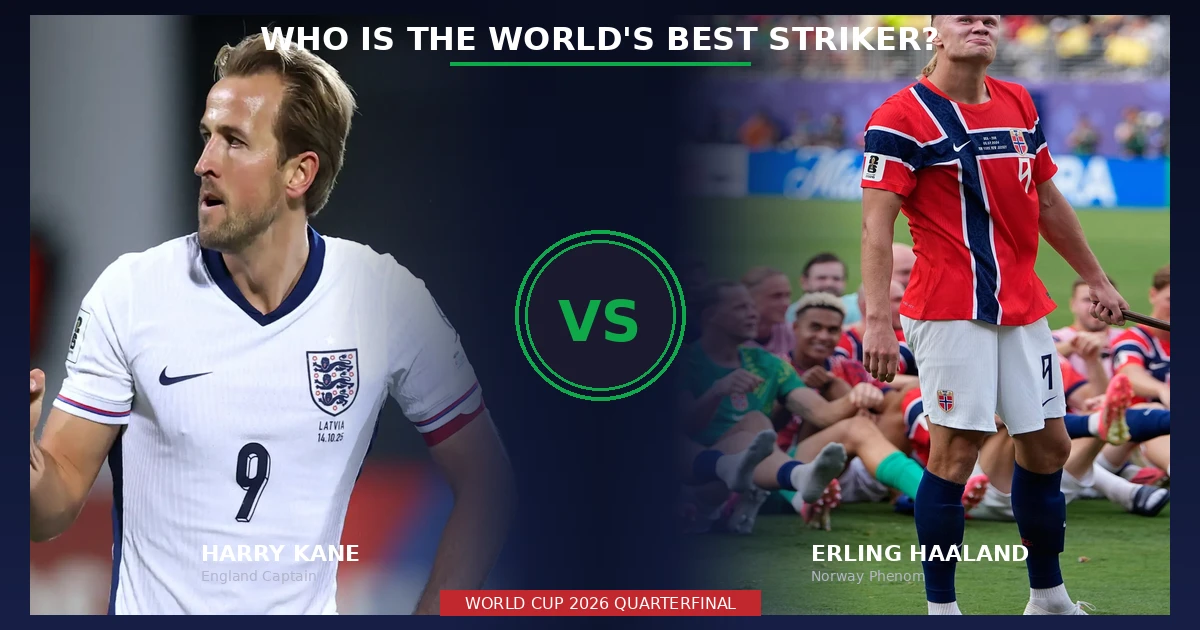
When the draw for the 2026 FIFA World Cup knockout stage was made, one fixture immediately leapt off the page. Not France vs Morocco, not Spain vs Belgium — though both carry immense weight. The match that captured the imagination of football purists was England vs Norway, a quarterfinal that pits the two finest number nines in the game against each other in the most high-stakes environment imaginable.
Harry Kane and Erling Haaland are, by any reasonable measure, the two best strikers on the planet. (For the purposes of this analysis, Kylian Mbappé is excluded — he operates primarily from wide positions and is a different archetype entirely.) Kane is 32, the England captain, a complete forward who could play as a number 10. Haaland is 24, the Norwegian phenomenon, a pure goal-scoring machine built for the penalty area. They represent two radically different visions of what a striker can be.
Their personalities are equally contrasting. Kane embodies elegance and professionalism — the consummate leader who leads by example. Haaland brings raw power and spectacle — a force of nature who turns matches in an instant. Saturday night in the Azteca, one of them will take a decisive step toward World Cup immortality. But who is the better player? We break it down across every dimension that matters.
⚔️ The Quarterfinal Showdown
Category by Category: The Breakdown
This is perhaps the tightest category. Haaland is almost exclusively a penalty-box striker — his role is to score, and he excels at it globally. But Kane is more complete. There is no type of finish he cannot execute: right foot, left foot, headers, long-range strikes, volleys, chips. Haaland may be more instinctive, but in terms of versatility and precision across all situations, Kane edges it.
Haaland's first goal against Brazil in the Round of 16 was a masterclass. He waited near the penalty spot, seemingly nonchalant, then exploded into the air above Gabriel — one of the world's best aerial defenders — and powered a header into the net. At 1.96m with elite athleticism and jump timing, Haaland is simply prolific in the air. Kane is effective; Haaland is devastating.
Football is rarely about top speed — it is about short accelerations and changes of pace. Kane's pace is his main weakness, though he is not as slow as some suggest. Haaland, however, operates on an entirely different level. In 2025, he recorded the highest sprint speed in the Champions League at 36.9 km/h, ahead of Achraf Hakimi and Kylian Mbappé. Over 30 meters, there are few players on Earth who can outrun him.
Haaland's genius is his ability to drift invisibly inside the box, then choose the exact moment to accelerate. When he gets a yard on a defender, it is already too late. Kane wants the ball at his feet constantly; Haaland is lethal without it. Averaging roughly one goal every 13 touches is not luck — it is the product of world-class spatial intelligence and timing.
This is where the gulf becomes a canyon. Kane is one of the best passers among strikers in football history. His ability to drop deep, link play, and thread defense-splitting passes — often with either foot — makes him a genuine number 10 in a number 9's body. Haaland's passing range is functional but limited. If you need a striker who creates as well as finishes, there is only one choice.
As England captain, Kane has carried the weight of a nation's expectations across three World Cups and two European Championships. He has scored in knockout stages, handled pressure, and maintained elite performance under scrutiny. Haaland, for all his brilliance, has not yet been tested as the leader of a team in a major tournament. Kane's experience and composure give him a decisive edge here.
Haaland's frame — 1.94m, 88kg of muscle — is built for the modern game. He brushes defenders aside, wins aerial duels against anyone, and has shown remarkable durability at Manchester City, rarely missing matches through injury. Kane has had his share of ankle and hamstring issues over the years. In a tournament context where recovery time is minimal, Haaland's physical resilience is a significant advantage.
Kane has scored in World Cup quarterfinals, semifinals, and the final itself. He has converted penalties under the brightest lights and delivered when England needed him most. Haaland's World Cup record is still being written — his goals against Brazil were his first in the knockout stages of a major international tournament. Until he proves it on the biggest stage, Kane's clutch pedigree remains unmatched.
The Numbers Don't Lie
| Stat | Harry Kane | Erling Haaland |
|---|---|---|
| Age | 32 | 24 |
| Height | 1.88m | 1.94m |
| World Cup 2026 Goals | 6 | 5 |
| Career World Cup Goals | 14 | 5 |
| Top Sprint Speed (2025) | 32.4 km/h | 36.9 km/h |
| Goals per 90 (Club 2025-26) | 0.78 | 1.12 |
| Assists per 90 (Club 2025-26) | 0.34 | 0.08 |
| Aerial Duels Won % | 48% | 67% |
| Key Passes per 90 | 2.1 | 0.9 |
| International Caps | 98 | 42 |
The Tale of the Tape
The statistics reveal the fundamental truth: Kane and Haaland are incomparable because they are incomparably different. Haaland's numbers in front of goal — 1.12 goals per 90 at club level, 67% aerial duel success, 36.9 km/h top speed — are the metrics of a physical phenomenon, a player who has been genetically and mentally engineered to put the ball in the net. He is the most efficient goal-scoring machine of his generation.
Kane's numbers tell a different story. His 0.34 assists per 90, 2.1 key passes per match, and 98 international caps reflect a player who sees the game two seconds before everyone else. He is not just a finisher — he is a creator, a linker, a conductor. In England's system, he is as likely to be found at the edge of the opposition box playing a through ball as he is tapping in from six yards. That versatility makes him uniquely difficult to defend against, but it also means he will never match Haaland's raw goal output.
What Saturday Will Decide
The England vs Norway quarterfinal is not merely a match — it is a referendum. For Kane, it is a chance to cement his legacy as one of the greatest strikers in English history, potentially leading his country to a first World Cup final since 1966. For Haaland, it is an opportunity to announce himself as the undisputed king of the position, to prove that his club-level dominance translates to the international stage when it matters most.
England enter as favorites. The Three Lions have already conquered the Azteca in this tournament and carry the momentum of a team that believes its time has come. Norway, meanwhile, eliminated Brazil in the Round of 16 — a result that shocked the footballing world and validated Haaland's ability to carry a nation on his shoulders. The Scandinavians play as a collective, but there is no doubt who their single icon is.
Tactically, the battle will be fascinating. England's defense — marshalled by John Stones and Marc Guéhi — will face its sternest test against Haaland's physicality and movement. Norway's backline, meanwhile, must contend with Kane's intelligence, his ability to drop deep and drag defenders out of position, creating space for Bukayo Saka and Phil Foden to exploit. Whoever wins their individual duel will likely decide the tie.
The Verdict
🏆 The Final Verdict
After analyzing every dimension — finishing, heading, speed, movement, playmaking, leadership, physicality, and clutch performance — the conclusion is clear but nuanced. Erling Haaland is the better goal-scorer. His combination of size, speed, aerial dominance, and instinctive finishing makes him the most lethal striker in the world inside the penalty area. If you need a goal and nothing else, Haaland is your man.
But Harry Kane is the better footballer. His completeness — the ability to score, create, lead, and perform under pressure — makes him the more valuable player in a team context. He elevates those around him in ways Haaland cannot yet match. For now, at least, the crown remains shared: Haaland owns the future, but Kane still owns the present.
Saturday night in Mexico City, the debate will not be settled by statistics or analysis — it will be settled by 90 minutes of football. One of these two extraordinary players will take a step closer to World Cup glory. The other will watch from the sidelines, knowing that the next chapter of their rivalry is already being written. For football fans, there is no greater spectacle.
🔗 More on Kooora Scores
Key Takeaways
- Haaland wins on physicality: Speed (36.9 km/h), heading dominance, and aerial duels (67%) make him the ultimate penalty-box threat.
- Kane wins on completeness: Playmaking (2.1 key passes/90), leadership, and big-game experience give him the edge in overall value.
- The quarterfinal is the decider: Saturday's England vs Norway clash will be the first true head-to-head test on the biggest stage.
- Different archetypes: Haaland is the pure finisher; Kane is the complete forward. Comparing them is comparing a sniper to a general.
- The future is Haaland's: At 24, Haaland has time to develop the dimensions Kane already possesses. The gap may close further.
Stay tuned to Kooora Scores for live match updates, post-match analysis, and complete coverage of the England vs Norway World Cup 2026 quarterfinal.