
AFCON 2027 is scheduled for 19 June to 17 July in Kenya, Tanzania and Uganda, bringing the men’s continental finals back to East Africa. Before that summer tournament, the qualifying competition has a November window to navigate. The most useful way to follow the next few months is to separate three questions: who hosts, who has qualified and what the remaining group games decide.
Key takeaways
- Kenya, Tanzania and Uganda jointly host the 2027 finals.
- The next qualifying window runs from 9 to 17 November 2026.
- Host-country groups have a different qualification rule.
- The final qualifying window follows in March 2027.
The tournament dates and the road there
CAF’s announcement of the opening and final dates provides the summer window. Its published qualifying calendar also identifies November’s third and fourth matchdays and the final two rounds in March. The periods below are international windows, not a promise that every team plays on the first and last day. Individual fixtures need their own date and venue check.
| Checkpoint | Published window |
|---|---|
| Qualifying matchdays 3–4 | 9–17 November 2026 |
| Qualifying matchdays 5–6 | 22–30 March 2027 |
| Final tournament | 19 June–17 July 2027 |
Those gaps change how a result should be read. A strong November can improve a team’s position without completing its campaign. A disappointing evening can leave a route open through the remaining fixtures. Keep the number of games played beside the points total, and avoid using a table screenshot without its date. A live group position can move again before the window closes.
Three hosts, but not three ordinary qualifying groups
The important exception appears in CAF’s qualifying draw and format explanation. Kenya, Uganda and Tanzania are automatically qualified. In their groups—D, H and L respectively—only the highest-ranked team other than the host earns the additional finals place. In the other groups, the general rule sends the top two through.
This is why a generic “top two qualify” graphic can mislead. Imagine a host finishes third: its automatic place does not simply turn the other two teams above it into qualifiers. The relevant comparison is the ranking among the non-host teams under the published rule. Before celebrating a qualification, identify the group and apply its actual conditions.
CAF’s September preview of the qualifying competition also highlights this distinction. Treat a result against a co-host as a competitive group match, while recognising that the host’s route to the finals is already secured. The match still belongs in the table; its significance is not identical for every participant.
Why the East African setting matters
CAF describes PAMOJA 2027 as the first AFCON shared by three countries. For supporters, that invites a different habit: think in terms of a specific match location rather than a single host-city base. A national team’s qualification tells you that it can take part; it does not, by itself, tell you where each of its tournament games will be staged.
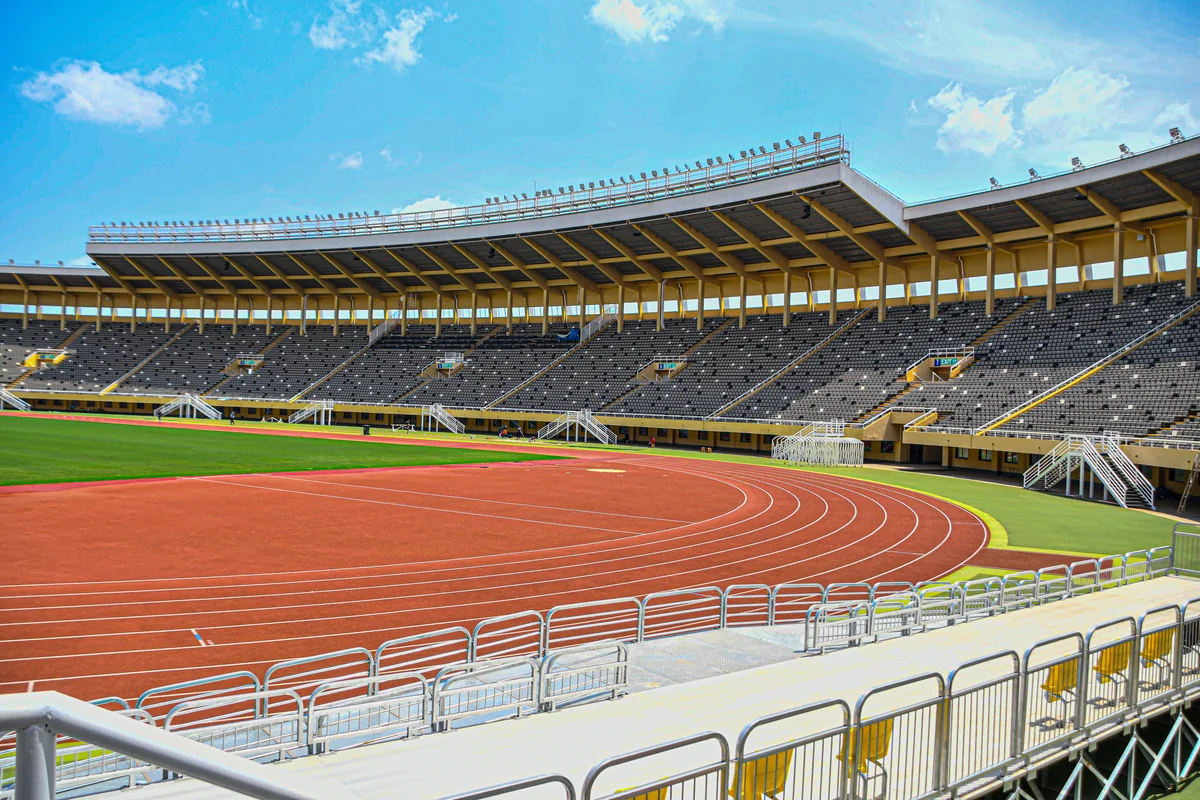
Our photograph shows Namboole in Uganda in February 2025. It gives this guide a real football setting, but it is not a live view of preparations or proof that a particular fixture has been assigned there. The same care applies to stadium images circulating online: an attractive ground photograph and an official match allocation are different pieces of information.
A better routine for the November qualifiers
Start with the federation’s squad announcement and the organiser’s fixture page. During the match, separate score updates from assessments of the performance. After full time, return to the group and ask what has actually changed: the points gap, the remaining opponents or a qualification condition. This takes a little longer than sharing the final score, but it produces a much better understanding of the campaign.
For Morocco-specific coverage, our guide to Morocco’s November AFCON qualifiers goes into the Atlas Lions’ programme. The Botola Pro centre covers domestic club football, a separate competition. Keeping those pathways distinct helps when a club player’s form becomes part of a national-team discussion.
The best preparation now is a clean calendar and a correct reading of the rules. Leave unconfirmed line-ups, ticket prices and venue assignments out of it. They will become useful facts when the responsible organiser publishes them, rather than when an enthusiastic preview makes them sound inevitable.
AFCON 2027 questions
Do the co-hosts need to qualify?
They have automatic places but take part in the qualifying groups under CAF’s published arrangements.
Does second place always qualify a non-host team?
No. In groups containing a host, only the highest-ranked non-host qualifies alongside that host.
When are the next two qualifying windows?
November 2026 and March 2027. The exact match dates should be checked against the organiser’s current listings.
Photo credit and official sources
Photo: Ssemmanda will / Wikimedia Commons · CC0. Cropped, resized and converted to WebP. This photograph and its prepared WebP versions are available under the linked license.